Collagen for Skin: What Actually Works (And What Most Products Get Wrong)
If you've spent any time looking at collagen supplements, you'll know the shelves are full of them. Powders, capsules, drinks, gummies, collagen-infused creams. The marketing is everywhere, the claims are bold, and it's genuinely hard to know what's worth your money and what isn't.
So let's cut through it. This article looks at the real science behind collagen for skin, what actually happens to your skin when collagen levels fall, and what to look for if you want to find the best collagen supplement for skin elasticity rather than just the best-marketed one.
Why Collagen Declines With Age
Your body produces collagen naturally. It's the most abundant protein in the human body, accounting for roughly 30% of total protein mass, and it forms the structural scaffold that keeps your skin firm, smooth, and resilient.
The problem is that collagen production starts declining at around age 25. By the time you're in your late 30s or 40s, that decline is noticeable. Research published in The American Journal of Pathology found that intrinsic skin ageing results in a roughly 1% reduction in dermal collagen content per year after the age of 21 (Varani et al., 2006). That's a steady, quiet loss that accumulates over decades.
UV exposure accelerates it. Smoking accelerates it. High sugar intake accelerates it, because a process called glycation damages collagen fibres and makes them brittle. So if you've spent years enjoying sunny holidays, the effects on your collagen stores can be more dramatic than the calendar suggests.
What Happens When Collagen Levels Drop
Think about what your skin looked like at 25 compared to now. That's not just nostalgia, it's collagen.
When collagen levels drop, the dermis, the deep layer of skin beneath the surface, loses density. Skin becomes thinner and less able to snap back into shape. Fine lines form, particularly around the eyes and mouth, where the skin is thinnest and moves most. Deeper wrinkles develop along expression lines because there's less structural support underneath. Skin starts to look hollower around the cheeks and temples.
For many women, the steepest drop happens around the menopause. Oestrogen plays a direct role in stimulating collagen synthesis, so when oestrogen levels fall sharply, collagen levels follow. Studies suggest women can lose up to 30% of their skin collagen in the first five years after menopause (Thornton, 2013, published in Dermato-Endocrinology). That's a significant and rapid change that many women notice firsthand as a sudden shift in skin texture and firmness.
Do Collagen Supplements Actually Work?
This is the question that matters, and the honest answer is: yes, there's genuine clinical evidence that collagen supplements can work, but the type, dose, and form all matter enormously.
A double-blind, placebo-controlled study by Proksch et al. (2014), published in Skin Pharmacology and Physiology, found that women aged 35 to 55 who took 2.5g or 5g of specific collagen peptides daily for eight weeks showed statistically significant improvements in skin elasticity compared to a placebo group. The effects were most pronounced in women over 50.
A further randomised controlled trial by Asserin et al. (2015), published in the Journal of Cosmetic Dermatology, demonstrated that oral hydrolysed collagen significantly increased skin hydration and led to measurable improvements in the density of the dermal collagen network after 12 weeks of daily supplementation.
These aren't fringe studies. They're properly designed clinical trials showing real, measurable results. But they used hydrolysed collagen peptides at specific doses, not raw collagen, not collagen cream, not collagen gummies with a negligible dose hidden behind a long ingredients list.
Why Hydrolysed Collagen Matters
Here's where a lot of products get it wrong. Collagen is a very large protein molecule. If you eat a piece of chicken skin or drink a bone broth, you're consuming collagen, but your digestive system breaks it down into amino acids that your body redistributes wherever it needs them. There's no guarantee any of it reaches your skin.
Hydrolysed collagen, also called collagen peptides, is different. The hydrolysis process breaks the collagen protein down into short peptide chains, typically 3,000 to 5,000 daltons in molecular weight. These smaller fragments are absorbed intact through the intestinal wall and can circulate in the bloodstream. Crucially, research suggests these specific peptides signal fibroblasts, the cells in your dermis responsible for producing collagen, to increase their output.
A study by Shigemura et al. (2009), published in the Journal of Agricultural and Food Chemistry, confirmed that collagen-derived dipeptides are detectable in human blood following oral supplementation, meaning they genuinely make it from your gut into your system rather than being fully dismantled during digestion.
So when you're looking at collagen for wrinkles and skin, what you're actually looking for is hydrolysed collagen peptides at a clinically relevant dose, typically 2.5 to 10g per day, not collagen as a vague label on a product with 500mg hidden in a proprietary blend.
Marine vs Bovine Collagen: Which Is Better?
This comparison comes up constantly, and it's worth being specific about the differences.
Bovine collagen, sourced from cattle hides or bones, is primarily Type I and Type III collagen. It's widely used, relatively cheap to produce, and the peptides are well-studied.
Marine collagen, derived from fish skin and scales, is almost exclusively Type I collagen, which is the primary structural collagen in human skin. The peptide molecular weight of marine collagen is typically lower than bovine, often around 3,000 daltons, compared to bovine at roughly 5,000 daltons or above. That smaller molecular size is thought to improve absorption rate and bioavailability.
This matters because the lower the molecular weight, the more efficiently the peptides cross the gut wall. A 2018 randomised, double-blind, placebo-controlled trial by Kim et al., published in Nutrients, gave 64 participants 1g per day of low-molecular-weight collagen peptide for 12 weeks. Compared to placebo, the treatment group showed statistically significant improvements in skin hydration, elasticity, and wrinkle depth, supporting the broader point that smaller peptide chains translate into measurable skin benefits. Since marine collagen sits at the lower end of the molecular-weight spectrum, this is consistent with what makes marine collagen peptides well-suited to skin-focused supplementation.
For collagen peptides absorption specifically, marine collagen has an edge. It's also free from mammalian proteins, which matters if you follow a halal diet, and it carries a lower allergenic risk for people with red meat sensitivities.
The practical difference in the bottle is this: if skin elasticity and collagen for wrinkles are your primary goals, marine collagen peptides are the better choice based on current evidence.
Why Collagen Needs Supporting Nutrients
Collagen doesn't work in isolation. Your body can't synthesise collagen without a steady supply of vitamin C. This isn't optional, it's biochemistry. Vitamin C is a required cofactor for the enzymes that stabilise and cross-link collagen fibres. Without adequate vitamin C, the collagen your fibroblasts are trying to produce is structurally weak and unstable.
Research published in the American Journal of Clinical Nutrition (Cosgrove et al., 2007) found that higher vitamin C intake was significantly associated with lower likelihood of a wrinkled appearance and skin dryness in women aged 40 to 74, even after adjusting for age, sun exposure, and other dietary factors.
Zinc is also essential. It acts as a cofactor in collagen synthesis and plays a role in wound healing and skin cell turnover. A study by Postlethwaite et al. (1984) demonstrated that zinc directly stimulates collagen production by fibroblasts in vitro.
Hyaluronic acid, while not involved in collagen synthesis directly, works alongside collagen in the dermis to attract and retain moisture. Skin that's well-hydrated looks plumper, more elastic, and shows fine lines less prominently. When both collagen and hyaluronic acid levels decline with age, the combined effect on skin texture is greater than either factor alone.
This is why a collagen supplement that includes vitamin C, zinc, and hyaluronic acid in addition to the collagen peptides themselves is likely to outperform a standalone collagen product.
Collagen for Skin, Hair, Nails and Joints
It's worth knowing that the same collagen supplementation that benefits your skin also supports hair and nails. Hair follicles are surrounded by collagen-rich connective tissue, and as collagen levels decline, that support structure weakens. Many women notice hair thinning or changes in texture from their mid-40s onwards, often alongside changes in skin quality, because the underlying cause is the same.
Nails similarly rely on the structural proteins maintained by collagen pathways. A study by Hexsel et al. (2017), published in the Journal of Cosmetic Dermatology, found that 24 weeks of specific collagen peptide supplementation led to a 12% increase in nail growth rate and a 42% decrease in the frequency of broken nails.
Collagen also forms approximately 65 to 80% of the dry weight of cartilage. If you're taking collagen for skin but also have stiff joints or early-stage joint discomfort, the same supplement is likely working on both simultaneously. You can read more about that connection in our [joint support blog].
What to Look for in a Premium Collagen Supplement
Not all collagen products are created equal, and given the price premium many of them carry, it's worth being precise about what actually separates a well-formulated supplement from one that looks good on the label.
First, check for hydrolysed marine collagen peptides as the primary active ingredient, not just "collagen" or "collagen protein." The hydrolysed form is the one with clinical evidence behind it.
Second, check the dose. A 2.5g to 10g daily dose is where the published research sits. Anything significantly below that, especially in a capsule with a long ingredient list, is likely underdosed.
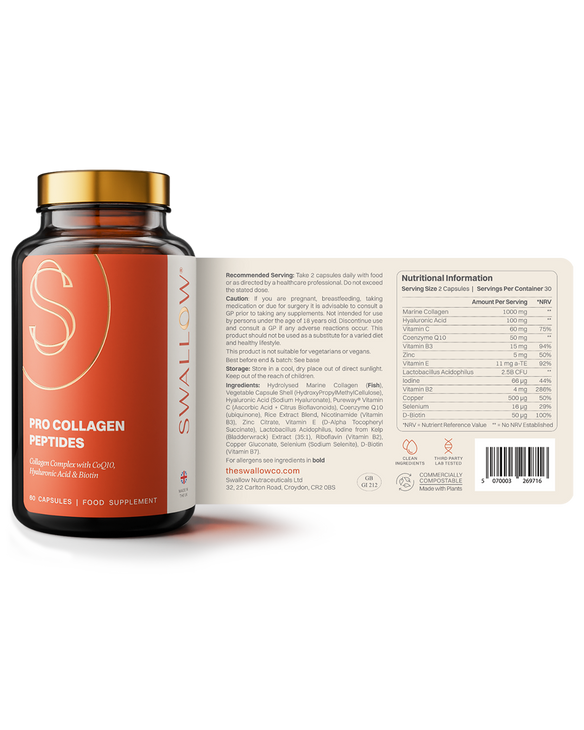
Third, look for vitamin C, ideally in a bioavailable form. PureWay-C® is a scientifically developed form of ascorbic acid containing lipid metabolites and citrus bioflavonoids, shown to achieve 225% better absorption than standard vitamin C. That matters because vitamin C is non-negotiable for collagen synthesis.
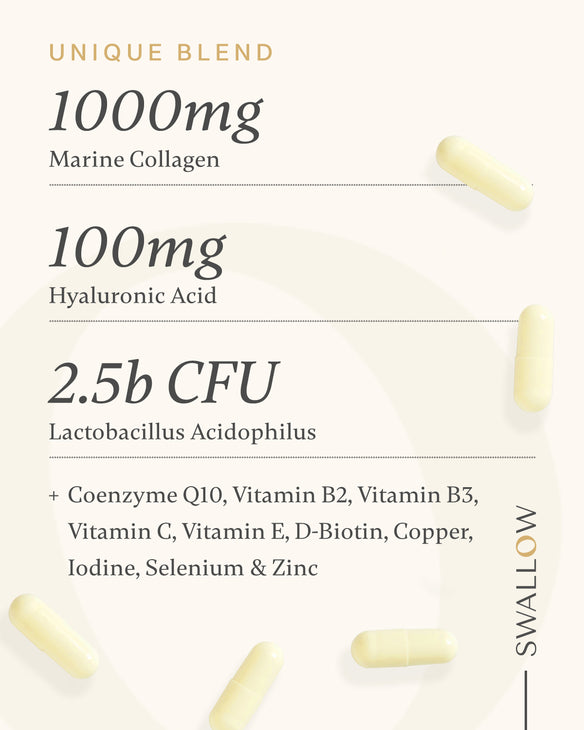
Fourth, check whether hyaluronic acid, zinc, and biotin are included. These aren't padding. They each play a specific, documented role in skin, hair, and nail health that works synergistically with collagen.
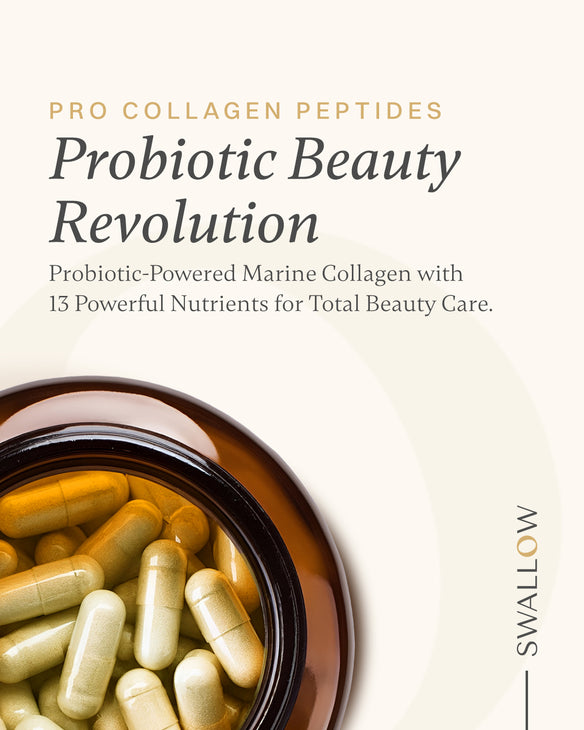
Swallow's [hydrolysed marine collagen with added nutrients] includes all of these in a single daily dose, formulated at clinically relevant levels.
References:
Proksch E et al. (2014). Skin Pharmacology and Physiology, 27(1).
Asserin J et al. (2015). Journal of Cosmetic Dermatology, 14(4).
Kim DU et al. (2018). Nutrients, 10(7).
Cosgrove MC et al. (2007). American Journal of Clinical Nutrition, 86(4).
Hexsel D et al. (2017). Journal of Cosmetic Dermatology, 16(4).
Thornton MJ (2013). Dermato-Endocrinology, 5(2).
Varani J et al. (2006). The American Journal of Pathology, 168(6).