Top 10 Collagen Mistakes (and How to Fix Them to Get Better Results)
Collagen is one of the best-researched supplements for skin and joint health, yet thousands of people try it, notice very little, and conclude it doesn't work. In reality, it's often not the collagen that's the problem. It's how they're taking it.
1. You're forgetting vitamin C
Collagen supplements provide the building blocks, but vitamin C is needed to actually build collagen. You don't need massive doses, but you do need enough.
Without enough vitamin C, the enzymes that stabilise newly formed collagen fibres cannot work properly. This is why severe vitamin C deficiency causes scurvy, where collagen literally starts falling apart.
Good sources include:
-
oranges
-
kiwis
-
strawberries
-
peppers
-
broccoli
How to fix it: Either choose a collagen supplement that already contains vitamin C or make sure your diet supplies enough each day.
2. You're using collagen that isn't properly hydrolysed
Whole collagen molecules are enormous.
Hydrolysed collagen has been broken down into much smaller collagen peptides that dissolve easily and are absorbed far more efficiently.
Many of these peptides survive digestion long enough to enter the bloodstream, where researchers think they may help stimulate the cells that produce new collagen.
How to fix it: Look for hydrolysed collagen peptides rather than plain collagen. Ideally look for a specific kilodalton size that is 2000 for marine collagen or 5000 for bovine collagen.
3. You're expecting results too soon
Collagen works by supporting your body's natural tissue renewal. That takes time.
In clinical studies:
-
skin improvements usually become measurable after 8-12 weeks
-
nail improvements often take 24 weeks
-
joint studies commonly run for 3-6 months
If you've only finished one tub, you may simply be judging it too early.
How to fix it: Commit to taking collagen consistently for at least three months.

4. You're expecting collagen to perform miracles
Collagen can improve hydration, elasticity and fine lines.
It cannot:
-
replace a facelift
-
rebuild severely damaged cartilage
-
erase deep wrinkles overnight
-
reverse decades of sun damage
The best results are usually seen when collagen is used early, before structural damage becomes severe.
How to fix it: Think of collagen as long-term maintenance rather than a quick cosmetic fix.
5. You're choosing the wrong type of collagen
Not all collagen supplements are the same. Different sources naturally contain different types of collagen, so the best choice depends on what you're hoping to improve.
If your main goal is healthier-looking skin, stronger hair and nails, or supporting tendons and ligaments, marine collagen is usually the best option because it is naturally rich in Type I collagen, the most abundant collagen in your body.
If you're looking for more general connective tissue support, bovine collagen provides both Type I and Type III collagen. Type III is commonly found alongside Type I in skin, blood vessels and many internal organs, making bovine collagen a popular all-round choice.
Your goal |
Best collagen source |
Why? |
|
Reduce wrinkles and improve skin elasticity |
Marine collagen |
Rich in Type I collagen, the main collagen found in skin. |
|
Support hair and nails |
Marine collagen |
Type I collagen provides the amino acids used to maintain skin, hair follicles and nails. |
|
Support tendons and ligaments |
Marine collagen or bovine collagen |
Both provide abundant Type I collagen, the main structural collagen in these tissues. |
|
General connective tissue support |
Bovine collagen |
Naturally contains both Type I and Type III collagen, which are widely distributed throughout connective tissues. |
|
Support cartilage and joints |
Marine or bovine collagen peptides |
Both have clinical evidence for helping joint pain, although cartilage itself is mainly made of Type II collagen. Most joint studies have used collagen peptides rather than focusing on the collagen source alone. |
One common misconception is that you must take Type II collagen for joint health. While cartilage is indeed rich in Type II collagen, many successful clinical trials showing improvements in joint pain have actually used hydrolysed marine or bovine collagen peptides, which are predominantly Type I. Scientists believe this is because collagen peptides act throughout connective tissues and may stimulate the cells responsible for maintaining cartilage, rather than simply replacing the collagen already there.
How to fix it: Choose your collagen based on your health goal, not just the collagen type listed on the label. For most people interested in healthier skin, hair and nails, marine collagen is the best fit. If you're looking for broader connective tissue support, bovine collagen is an excellent alternative.
6. You're not taking enough collagen
Many collagen products provide just 1-2 g per serving, but most of the clinical trials showing benefits used 2.5g to 10 g per day, depending on the outcome being studied. That’s about half a teaspoon up to a whole desert spoon.
Generally speaking:
-
2.5 g has been shown to improve skin hydration and elasticity in several studies.
-
5 g is commonly used for skin ageing and wrinkle studies.
-
10 g is more common in studies looking at joints, tendons and sports recovery.
If you're taking less than the amount used in the research, it's hardly surprising you aren't seeing the same results.
How to fix it: Choose a supplement that provides a clinically relevant daily dose.
7. You're not giving your body the nutrients it also needs
Collagen supplements provide the raw materials your body needs to build new collagen, but they can't do the job alone. Making healthy connective tissue is a complex process involving dozens of enzymes, and several vitamins and minerals are needed to keep those enzymes working properly.

If one or more of these nutrients is in short supply, your body may struggle to make the most of the collagen you're taking. That's one reason why some people see excellent results while others notice very little.
The nutrients collagen relies on
Nutrient |
Why it matters for collagen |
|
Vitamin C |
The most important partner nutrient. Your body needs vitamin C to stabilise newly formed collagen fibres by helping the enzymes that convert proline and lysine into hydroxyproline and hydroxylysine. Without enough vitamin C, collagen becomes weak and poorly formed, which is why severe deficiency causes scurvy. |
|
Protein |
Collagen is a protein, so your body needs enough dietary protein to manufacture new connective tissue. Even if you take collagen peptides, an overall low protein intake may limit your body's ability to repair and maintain tissues. |
|
Zinc |
Zinc helps activate enzymes involved in tissue repair, cell division and protein synthesis. It also supports normal wound healing, making it an important mineral whenever your body is producing new connective tissue. |
|
Copper |
Copper activates an enzyme called lysyl oxidase, which forms the strong cross-links that give collagen fibres their tensile strength. Without enough copper, collagen can be produced but may be weaker and less resilient. |
|
Vitamin A |
Vitamin A helps regulate the activity of fibroblasts, the cells responsible for producing collagen. It also supports healthy skin turnover and plays an important role in wound healing. |
Think of collagen as the bricks needed to build a house. These nutrients are the builders, tools and cement that allow those bricks to be assembled into a strong, stable structure. Without them, simply adding more collagen may not deliver the results you're hoping for.
How to fix it: Aim for a balanced diet containing plenty of protein, colourful fruit and vegetables, wholegrains, nuts and seeds. If your collagen supplement already includes vitamin C, that's one less thing to worry about, but it's still important that the rest of your diet provides the nutrients needed for healthy collagen production.
8. You're expecting collagen to fix problems caused by something else
Not every wrinkle is caused by collagen loss. Not every painful joint is caused by worn cartilage. Not every brittle nail is caused by poor collagen production.
Your symptoms may instead be due to:
-
menopause
-
iron deficiency
-
thyroid disease
-
dehydration
-
chronic inflammation
-
excessive UV exposure
-
smoking
Collagen can't fix problems it didn't cause.
How to fix it: Consider the bigger picture if collagen isn't helping after several months.
9. You're damaging collagen faster than your body can replace it
Your body is constantly making new collagen. Unfortunately, it's constantly breaking it down too. Some of the biggest collagen destroyers are:
-
smoking
-
excess UV exposure
-
high sugar intake
-
excessive alcohol
-
chronic inflammation
-
poor sleep
You can't expect a supplement to completely overcome habits that accelerate collagen breakdown.
How to fix it: Protect the collagen you already have by wearing sunscreen, avoiding smoking, eating a balanced diet and prioritising sleep.
10. You're buying collagen based on marketing instead of science
Collagen is one of the most heavily marketed supplements on the market, which makes it surprisingly difficult to compare products. Terms such as "beauty collagen", "premium collagen", "bioactive collagen" and "youth collagen" sound impressive, but there are no standard definitions for these claims. They tell you very little about how effective the product is likely to be.
Instead of judging a collagen supplement by the front of the pack, turn it over and read the nutrition panel. That's where you'll find the information that really matters.
Look for... |
Why it matters |
|
A clinically relevant dose |
Most successful clinical studies use between 2.5 g and 10 g of collagen peptides per day, depending on the health outcome being studied. |
|
Hydrolysed collagen peptides |
Hydrolysed collagen has been broken down into small peptides that are much easier to absorb than whole collagen. |
|
The right collagen type |
Type I is best suited to skin, tendons and bone, while Type II is primarily found in cartilage. |
|
Vitamin C |
Your body cannot produce healthy collagen without enough vitamin C, making it one of the most valuable supporting ingredients. |
|
A transparent formula |
Good brands clearly state the collagen source, daily dose and active ingredients, rather than hiding behind proprietary blends or vague marketing claims. |
How to fix it: Don't buy the product with the prettiest packaging or the biggest promises. Buy the one with the ingredients, doses and formulation that most closely match the successful clinical trials. That's what gives you the best chance of seeing real results.
The bottom line
If collagen hasn't worked for you, don't assume collagen itself is the problem. In many cases it's simply the wrong product, too small a dose, not enough time, or missing nutrients such as vitamin C. The best clinical studies consistently use hydrolysed collagen peptides, taken every day for at least 8 to 12 weeks, alongside a diet that provides the nutrients needed for healthy collagen production.
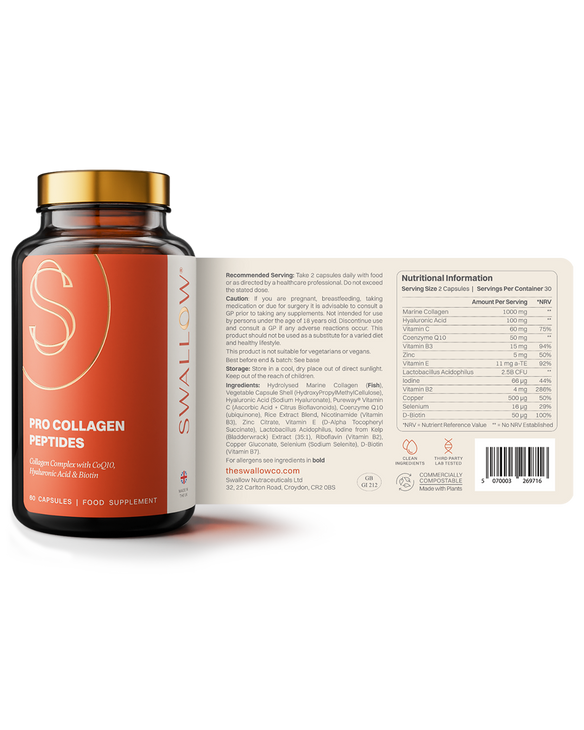
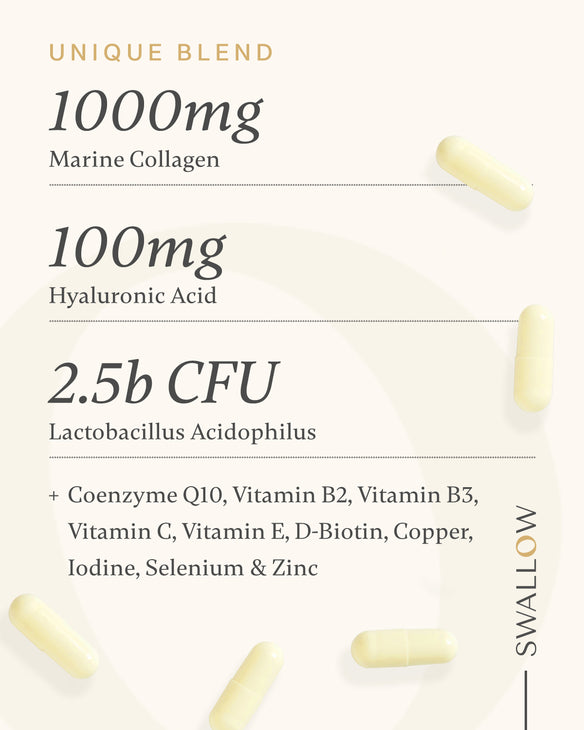
Our Swallow Marine Collagen has been formulated with exactly these principles in mind. It provides a clinically relevant dose of hydrolysed marine collagen peptides, naturally rich in Type I collagen, together with vitamin C to support normal collagen formation. That means you're avoiding several of the most common mistakes people make before you even open the tub, giving yourself the best chance of seeing the improvements in skin, joints and connective tissue that collagen supplementation can genuinely offer.