Why Is My Skin Losing Elasticity? Nutrients That Support Collagen, Hydration and Glow
You catch yourself in a well-lit mirror and notice something has shifted. The skin that used to spring back doesn’t quite have the same bounce. Fine lines have deepened slightly around your eyes. Your complexion looks a little flatter than it used to, less lit from within. It’s not dramatic, but it’s noticeable. And it’s happening faster than you expected.
This is what collagen decline actually looks like in real life. Not sudden, but cumulative. And it starts earlier than most people realise, collagen synthesis begins to fall at a rate of 1-1.5% per year from around age 25. By the time you’re in your forties or fifties, that’s two decades of compound loss in the structural protein responsible for your skin’s firmness, bounce, and density.
The encouraging part is that this decline is modifiable. A growing body of clinical research confirms that targeted nutrition, specifically collagen peptides, vitamin C, hyaluronic acid, and CoQ10, can meaningfully slow or partially reverse these changes. Not through expensive serums that sit on the surface, but by giving your body the building blocks it needs to produce and protect collagen from within.
What Is Actually Happening to Your Skin?
Skin elasticity depends on two structural proteins working together: collagen and elastin. Collagen provides tensile strength, it’s the scaffolding that holds the skin’s structure in place. Type I collagen makes up over 90% of skin’s collagen content. Elastin gives the skin its ability to stretch and snap back. When you press your cheek and it returns to shape, that’s elastin doing its job.
Both proteins are produced by fibroblasts, specialised cells in the dermis (the deep layer of your skin). As you age, fibroblast activity slows, the number of active fibroblasts decreases, and the enzymes involved in collagen synthesis become less efficient. At the same time, levels of glycosaminoglycans, including hyaluronic acid, decline in both the epidermis and dermis. Hyaluronic acid is the molecule responsible for keeping skin cells hydrated; it can hold up to 1,000 times its own weight in water. As it depletes, skin loses volume, fullness, and that ‘plump’ quality that characterises younger skin.
Oxidative stress compounds all of this. UV exposure, pollution, poor sleep, and dietary choices all generate free radicals that damage existing collagen fibres and activate matrix metalloproteinases (MMPs), enzymes that degrade both collagen and elastin. This is the mechanism behind skin that looks prematurely aged: it’s not just about what you’re not building, but also about what’s being actively broken down.
The practical upshot: effective skin support works on three levels simultaneously, stimulating new collagen production, protecting existing collagen from degradation, and maintaining skin hydration from within.
Does Collagen for Wrinkles Actually Work? What the Research Shows
This is the question most people want answered honestly. And the evidence is genuinely encouraging, provided you understand what the research measured and how.
A systematic review and meta-analysis published in the Indian Journal of Dermatology, Venereology and Leprology (IJDVL) analysed ten randomised controlled trials involving 646 participants to assess the impact of collagen-based supplements on skin ageing. The findings were statistically significant on both key measures. Collagen supplements were effective in increasing skin hydration (SMD 1.25; CI 0.77–1.74) and elasticity (SMD 0.61; CI 0.21–1.02). Oral doses of 1–10g per day were shown to be effective. The review followed PRISMA 2020 guidelines and drew from PubMed, Clinical Key, ProQuest, and the Cochrane Library.
How does it work? The review confirmed two distinct pathways. First, hydrolysed collagen breaks down into free amino acids (particularly glycine, proline, and hydroxyproline) that directly support the synthesis of new collagen, elastin, and hyaluronic acid, while suppressing MMP-2, one of the enzymes that degrades existing type IV collagen. Second, collagen oligopeptides, specifically the tripeptide Gly-Pro-Hyp, bind directly to fibroblast receptors in the dermis and signal them to increase their production of collagen, elastin, and hyaluronic acid. This isn’t a passive process, collagen peptides actively trigger dermal regeneration at a cellular level.
A separate clinical study by Czajka et al., published in Nutrition Research (ScienceDirect, 2018), reported for the first time a significant increase in skin elasticity and reduction in photo-ageing following supplementation with a multi-component formula containing collagen peptides and vitamins. The same study found significant improvements in joint health in subjects aged 51–70, with reduced joint discomfort and increased mobility, a reminder that the same collagen-building nutrients benefit connective tissue throughout the body, not just the face.
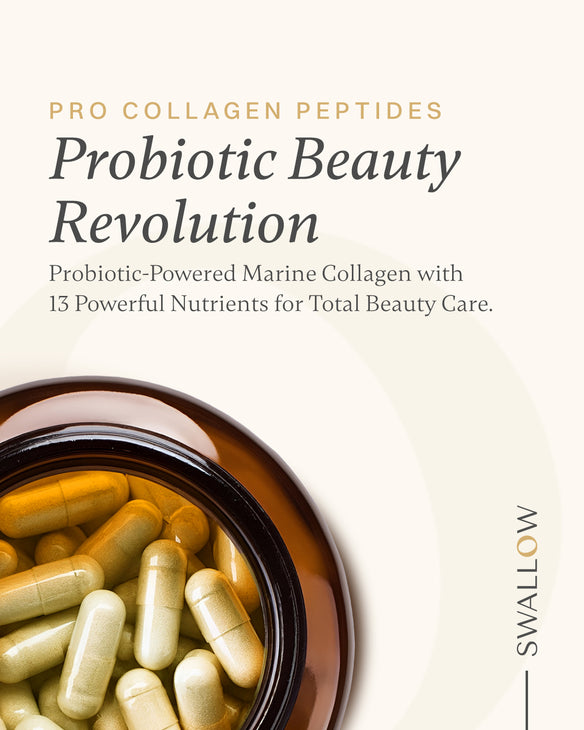
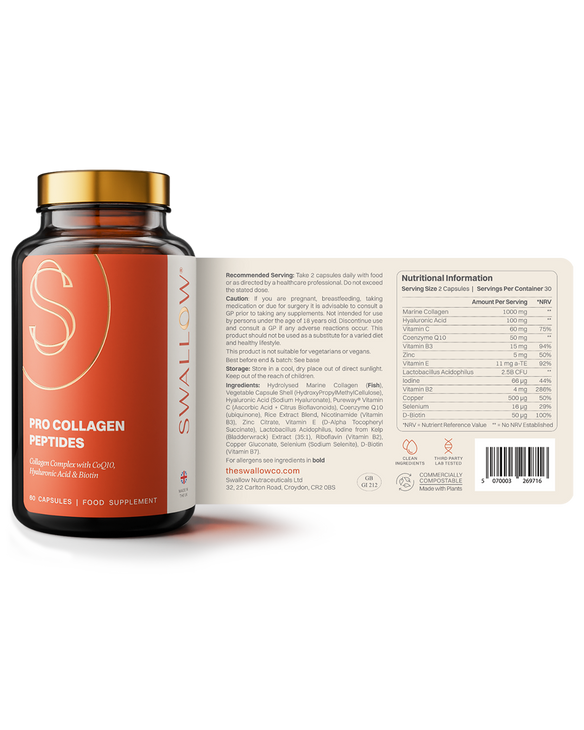
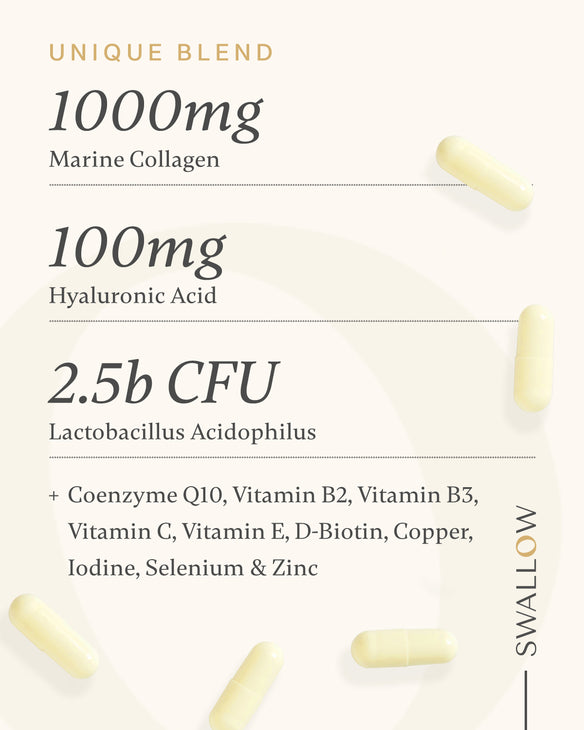
Marine collagen is particularly well-suited for skin absorption. Its smaller peptide size gives it higher bioavailability than bovine collagen, meaning more of what you take actually reaches the dermis where fibroblasts can act on it. Our Marine Collagen Peptides are hydrolysed to low molecular weight and combined with 13 complementary beauty nutrients, including vitamin C, zinc, and biotin, for synergistic collagen support.
Why Vitamin C Is Non-Negotiable for Collagen Synthesis
Vitamin C is not a supporting ingredient in skin nutrition, it is a biological requirement for collagen formation. This distinction matters because collagen supplements consumed without adequate vitamin C cannot be fully converted into functional collagen fibres in the skin.
The 2024 Medicina review of 14 nutritional compounds and their effects on skin (Wolanin et al., MDPI), which analysed 238 articles, was explicit on this: normal healthy skin contains high concentrations of vitamin C (L-ascorbic acid), which assists in antioxidant defence against UV-induced photodamage and induces collagen biosynthesis. The main cutaneous collagens are types I and III, both of which are produced less with ageing. The review confirmed that vitamin C benefits skin physiology through collagen induction, meaning it actively stimulates the production of new collagen, not merely assists with it.
The mechanism is specific: vitamin C is a cofactor for prolyl hydroxylase and lysyl hydroxylase, the enzymes that hydroxylate proline and lysine residues during collagen synthesis. Without this hydroxylation step, collagen cannot form its stable triple helix structure. The resulting collagen is weaker and degrades faster. So if you’re taking collagen peptides without sufficient vitamin C, you’re providing the raw materials but missing the enzyme activation that turns them into usable structure.
Vitamin C does a second job simultaneously: it is one of the most potent water-soluble antioxidants in the body, neutralising the free radicals that drive oxidative stress and collagen degradation. The combination of stimulating production and protecting existing structure is why vitamin C consistently shows up as a critical co-nutrient in the most effective skin supplement formulations.
Hyaluronic Acid: The Skin’s Internal Moisture System
If collagen and elastin give skin its structure and spring, hyaluronic acid gives it volume and hydration. This glycosaminoglycan molecule is found in both the epidermis and the dermis, and its ability to attract and retain water, up to 1,000 times its own weight, is what creates the ‘full’, plumped quality of younger skin.
The problem is that hyaluronic acid levels in the skin drop measurably with age. By your forties, dermal concentrations are significantly lower than they were in your twenties. Skin becomes thinner, loses volume, and dries more easily. And because elastin conformation, the way elastin fibres arrange themselves to create bounce, is actually dependent on hydrated proteins, low hyaluronic acid doesn’t just cause dryness. It also directly reduces elasticity.
This is why the combination of collagen peptides with hyaluronic acid is clinically well-supported. The Czajka et al. study included hyaluronic acid as part of the multi-component formula that produced significant elasticity and photo-ageing improvements. And the IJDVL review confirmed that collagen oligopeptides actively stimulate hyaluronic acid production by fibroblasts, meaning collagen supplementation doesn’t just build collagen, it also drives the body’s internal hyaluronic acid production.
CoQ10: Protecting the Skin You’re Building
You can stimulate all the new collagen synthesis you want, but if oxidative stress keeps degrading it as fast as you build it, results will be limited. This is the role CoQ10 plays in skin nutrition: it is the body’s primary lipid-soluble antioxidant, protecting cell membranes, including those of dermal fibroblasts, from free radical damage.
CoQ10 is also a critical component of the mitochondrial electron transport chain, meaning it supports the cellular energy production that fibroblasts need to synthesise collagen and other extracellular matrix proteins. In practical terms: without adequate CoQ10, the cells responsible for making your skin’s structure have less energy to work with and are more vulnerable to oxidative damage.
A randomised, double-blind, placebo-controlled study published in PMC assessed the effects of 50mg water-soluble CoQ10 combined with 4g fish collagen over 12 weeks. The combination improved dermis density, reduced periorbital wrinkle area, and improved skin smoothness. A separate study confirmed that 2.5g collagen peptides over 8 weeks increased procollagen type I and elastin content and decreased eye wrinkle volume. These aren’t marginal improvements, they are objectively measured changes in dermal structure.
Natural CoQ10 levels begin to decline from the mid-thirties. Our Daily Multivitamin includes CoQ10 as part of a comprehensive formula, alongside vitamin C, methylated B vitamins, and zinc, all of which support the cellular environment in which skin regeneration occurs.
Omega-3s, the Skin Barrier, and Why Fat Matters
Skin doesn’t just need structural proteins, it also needs an intact lipid barrier to retain moisture. The skin’s outer layer, the stratum corneum, contains a mix of ceramides, fatty acids, and cholesterol that prevents transepidermal water loss (TEWL). When this barrier is compromised, through dehydration, weather, or a diet low in essential fatty acids, moisture escapes, skin feels dry and tight, and fine lines become more visible even when underlying collagen is intact.
Omega-3 fatty acids, particularly EPA and DHA, support the skin barrier through two mechanisms. First, they are incorporated into cell membrane phospholipids, where they influence membrane fluidity and the expression of genes involved in barrier function. Second, EPA has well-documented anti-inflammatory properties, reducing the inflammatory signalling that activates MMPs and accelerates collagen degradation. The 2024 MDPI Medicina review confirmed omega-3 as one of 14 nutritional compounds with demonstrable positive effects on skin health, based on 238 reviewed articles. Our High-Strength Omega-3 provides concentrated EPA and DHA in a triglyceride form for optimal absorption.
Hair, Nails, and the Same Nutritional Pathway
The nutrients that support skin structure also support keratin synthesis, the primary structural protein of hair and nails. Collagen peptides provide glycine and proline, amino acids used in keratin formation. Zinc supports the enzymatic processes involved in growth and repair. Biotin is the co-enzyme essential for keratin biosynthesis. Vitamin C supports the cross-linking of keratin fibres.
This is why people investing in collagen and beauty supplementation often notice improvements across all three areas. Brittle nails that used to peel. Hair that feels thicker and breaks less easily. Skin that holds moisture better. These aren’t separate effects from separate mechanisms, they’re expressions of the same underlying nutritional improvement.
Gut health plays a surprisingly important role in how effectively all of these nutrients are absorbed. The gut microbiome influences nutrient bioavailability, and an imbalanced microbiome can reduce how much collagen-supporting amino acids and vitamins actually reach the skin. Our Probiotic Live Cultures supports the gut environment that makes skin nutrition work properly, not just a digestive supplement, but a prerequisite for getting the most from everything else you take.
What Makes a Skin Supplement Worth Taking?
With hundreds of collagen products on the market, the differences between a formulation that produces measurable results and one that doesn’t come down to a handful of factors.
Hydrolysed collagen, not native. Native collagen molecules are too large to be absorbed through the intestinal wall. Hydrolysed collagen, broken into di- and tripeptides, is absorbed efficiently and, as the IJDVL meta-analysis confirmed, reaches effective concentrations in the bloodstream and subsequently in dermal tissue. The molecular weight of the peptides matters: lower molecular weight means faster absorption and greater distribution to skin tissue.
Marine over bovine for skin specifically. Marine collagen is predominantly type I, the same collagen that makes up over 90% of skin. Its smaller peptide size gives it higher bioavailability than bovine collagen. It reaches the dermis faster and in greater concentration.
Vitamin C must be present and in sufficient dose. As established by the MDPI Medicina review, collagen biosynthesis cannot proceed without vitamin C. A collagen supplement without vitamin C, or with a token dose, is structurally incomplete. Look for at least 80mg per serving.
CoQ10 for protection, not just production. Building new collagen while leaving it exposed to free radical degradation is counterproductive. CoQ10 as the body’s lipid-soluble antioxidant protects the dermis from the oxidative stress that undoes collagen synthesis.
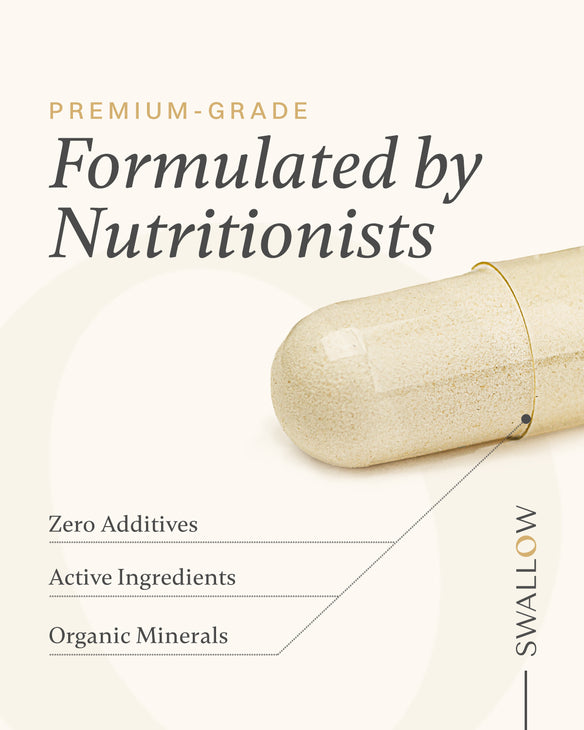
Third-party testing. Every Swallow product is independently tested to verify that the ingredients match the label, the right forms, the right doses, no contaminants. This is especially important for collagen, where molecular weight and purity affect bioavailability.
Explore our complete range of beauty supplements, formulated with these principles and designed for long-term skin support, not short-term water retention that mimics surface results.
How Long Before You See a Difference?
Honest answer: it depends on where you’re starting from and what you’re measuring.
Skin hydration tends to improve earliest, many people notice their skin feels less dry and more comfortable within 2–4 weeks of consistent supplementation. This reflects the hyaluronic acid and barrier-supporting effects of omega-3s rather than new collagen synthesis.
Elasticity and firmness changes take longer because they reflect actual changes in dermal collagen density. The Czajka et al. study showed significant elasticity improvements at 60 days. The IJDVL meta-analysis found that older subjects showed more gradual improvements, with effects emerging more clearly after 60 days than in younger participants, likely reflecting age-related differences in nutrient absorption and baseline fibroblast activity.
The clinical evidence broadly points to 8–12 weeks of consistent daily supplementation as the threshold where measurable structural improvements in dermis density, elasticity, and wrinkle depth become detectable by objective measurement tools. Not a quick fix. But consistent, accumulating change in the actual structure of the dermis.
Supporting Your Skin From Within With The Swallow
The skin you see in the mirror today reflects years of collagen production and, increasingly, collagen loss. You can’t reverse time, but you can give your body the specific nutrients it needs to rebuild more, degrade less, and retain the moisture and density that keep skin looking and feeling healthy. Explore our full range of beauty supplements, each formulated with bioavailable ingredients, clinically relevant doses, and third-party tested quality.
Sources
Wolanin, M. et al. (2024). Nutritional Supplements for Skin Health—A Review of What Should Be Chosen and Why. Medicina, 60(1), 68. https://www.mdpi.com/1648-9144/60/1/68
Czajka, A., Kania, E.M., Genovese, L., Corbo, A., Merone, G., Luci, C. & Sibilla, S. (2018). Daily oral supplementation with collagen peptides combined with vitamins and other bioactive compounds improves skin elasticity and has a beneficial effect on joint and general wellbeing. Nutrition Research, 57, 97-108. https://www.sciencedirect.com/science/article/abs/pii/S0271531717311508
Danessa, B. et al. Effects of collagen-based supplements on skin’s hydration and elasticity: A systematic review and meta-analysis. Indian Journal of Dermatology, Venereology and Leprology (IJDVL). https://ijdvl.com/effects-of-collagen-based-supplements-on-skins-hydration-and-elasticity-a-systematic-review-and-meta-analysis/