Why Your Skin Looks Tired (Even When You're Not) - Nutritional Causes Explained
You look in the mirror and something's off. The skin looking back at you is flat, slightly grey, a bit hollow around the eyes. Not ill exactly, but not right either. You've been sleeping reasonably well, drinking water, working through your skincare routine. And yet your complexion has that particular kind of dullness that makes people ask if you've been under the weather.
That look, tired skin without a clear cause, is usually a nutritional story, not a hydration story or a sleep story. It happens because several things are declining simultaneously beneath the surface, and no moisturiser addresses what's actually going on. This article covers the specific biological reasons dull skin causes develop, what nutrients are involved, and how to improve skin from within using supplements for tired looking skin that have real clinical evidence behind them.
What Causes Dull, Tired-Looking Skin?
Dull, tired-looking skin isn't one problem. It's typically several things converging at once, each making the others worse.
Reduced microcirculation is one of the earliest and most overlooked factors. Your skin cells are fed by a dense network of capillaries, and when circulation is sluggish, whether from low iron, sedentary habits, or chronic stress, those cells receive less oxygen and fewer nutrients. Iron carries oxygen to every cell in your body via haemoglobin. When iron stores fall below optimal, skin oxygenation drops first, because the body redirects available iron to more critical functions. A study by Sinclair (2002), published in Clinical Dermatology, identified iron deficiency as a direct cause of skin pallor and the loss of healthy colour and luminosity in the complexion, measurable even before anaemia technically develops.
Skin cell turnover is the other major variable. Healthy skin sheds its outermost layer every 28 to 40 days and replaces it with new cells from below. That cycle slows with age and with nutrient deficiencies, particularly B vitamins and zinc, which are essential cofactors in cellular replication. When turnover slows, dead skin cells accumulate on the surface for longer, scattering light unevenly and creating the flat, low-luminosity look that makes skin appear tired even on a rested face.
Then there's the structural dimension. Collagen in the dermis acts as a reflective scaffold. Young, well-hydrated skin with dense collagen reflects light evenly across the surface. As collagen thins and the dermis loses density, that reflective quality degrades. The hollowing under the eyes, the slight flatness in the cheeks, the loss of the healthy translucency that characterises youthful skin, these are all manifestations of structural decline, not cosmetic issues you can address from the outside.
How Oxidative Stress Affects Skin Appearance
If you live in a city, spend any time outdoors, or have ever smoked, your skin has accumulated oxidative damage. This is the mechanism behind dull skin causes that most skincare marketing doesn't explain clearly.
Free radicals, unstable molecules generated by UV radiation, air pollution, cigarette smoke, and even normal metabolic processes, attack the structural proteins of the dermis when antioxidant defences are insufficient to neutralise them. They degrade collagen and elastin fibres, damage the lipid barrier of skin cells, and impair the function of the mitochondria inside those cells, reducing the energy available for repair and regeneration.
A comprehensive review by Rinnerthaler et al. (2015), published in Biomolecules, established that oxidative stress is a primary driver of both photoaging and intrinsic skin aging, directly damaging mitochondrial and nuclear DNA in skin cells and activating matrix metalloproteinase enzymes that break down the collagen matrix. The research identified UV-induced oxidative damage as responsible for approximately 80% of facial skin aging visible by middle age.
The grey, slightly lifeless quality that develops over years of urban living and sun exposure is largely the accumulated result of oxidative damage. Antioxidant nutrients, vitamin C, vitamin E, selenium, and CoQ10, neutralise free radicals before they degrade skin proteins. But dietary antioxidant status declines with age and with poor diet quality, and topical antioxidants penetrate the dermis poorly compared to what can be achieved through oral supplementation.
A review by Schagen et al. (2012), published in Dermato-Endocrinology, found that dietary antioxidant status directly correlates with measurable skin aging markers including collagen density, skin surface texture, and the rate of oxidative protein damage in the dermis.
|
RESEARCH NOTE UV-induced oxidative stress accounts for approximately 80% of visible facial skin aging by middle age, according to Rinnerthaler et al. (2015). Free radical damage to collagen, elastin, and mitochondrial DNA in skin cells drives the dull, flat skin appearance that accumulates silently over decades. |
Why Hydration Alone Isn't Enough
The advice to 'drink more water' is not wrong, but it's radically incomplete as a strategy for how to improve skin from within.
Water intake increases the volume of fluid in circulation, but whether that fluid actually reaches your skin cells and stays there depends entirely on the structural integrity of the dermis. The dermis retains moisture through a matrix of collagen fibres, proteoglycans, and hyaluronic acid molecules, each of which holds water in place at the cellular level. Drinking more water doesn't rebuild that matrix. It just increases the supply of water to a structure that may no longer be able to hold it.
A study by Palma et al. (2015), published in Skin Research and Technology, found that increasing daily water intake from low to adequate levels did improve surface hydration parameters, but the effect was modest compared to the improvements seen when skin barrier function itself was restored. The skin barrier, the outermost protective layer, depends on fatty acids, ceramides, and zinc to maintain its integrity. When those are deficient, water evaporates from the skin surface at an accelerated rate, a process called transepidermal water loss (TEWL), regardless of how much you drink.
Deep dermal hydration is maintained by hyaluronic acid, a glycosaminoglycan that can bind up to 1,000 times its own weight in water. Hyaluronic acid concentration in the dermis peaks in your 20s and falls steadily thereafter. By your 50s, the structural water-retention capacity of the dermis has declined significantly, and no amount of drinking replaces what the tissue has lost.
Oral supplementation with nutrients that rebuild or support the dermis's water-retention capacity, collagen peptides, hyaluronic acid, and vitamin C, addresses the underlying deficit. Drinking water adequately is a prerequisite, not a treatment.
The Role of Collagen in Skin Structure
Collagen makes up approximately 80% of the dry weight of the dermis. It's not just a plumping agent, it's the fundamental structural framework that determines how your skin looks, feels, and reflects light.
Type I collagen, the primary structural collagen in skin, forms long, tightly wound fibres that give the dermis its tensile strength and firmness. These fibres also provide the physical surface from which light bounces. Young, collagen-dense skin has an almost luminous quality because light reflects evenly off a well-structured, uniform dermal surface. As collagen density falls, that reflective quality degrades. The skin becomes slightly concave in areas under the eyes and along the cheeks, light no longer bounces uniformly, and the result is the flat, tired appearance that is so familiar by the mid-40s.
Collagen production starts declining at approximately 25 years of age, falling by roughly 1% per year. UV exposure, smoking, high sugar intake through a process called glycation, and low vitamin C all accelerate the rate of decline. By the time you reach your late 40s or early 50s, the cumulative loss is significant enough to visibly change facial structure.
The clinical evidence for hydrolysed collagen peptides is covered in detail in our collagen article, but the key finding from Proksch et al. (2014), published in Skin Pharmacology and Physiology, is directly relevant here: women aged 35 to 55 taking 2.5g to 5g of specific collagen peptides daily for eight weeks showed statistically significant improvements in skin elasticity compared to placebo, with more pronounced effects in women over 50. The mechanism, confirmed by Shigemura et al. (2009) in the Journal of Agricultural and Food Chemistry, is that hydrolysed collagen dipeptides survive digestion, enter the bloodstream intact, and signal fibroblasts in the dermis to increase their collagen output.
|
KEY FINDING Collagen density in the dermis falls by approximately 1% per year from age 25. By the late 40s, cumulative loss is sufficient to visibly alter facial structure, reduce light reflectivity, and contribute to the flat, dull skin appearance that persists regardless of sleep and hydration. |
Why Hyaluronic Acid Supports Skin Hydration
Hyaluronic acid is the dermis's primary water-retention molecule. A single hyaluronic acid molecule can hold up to 1,000 times its molecular weight in water, and in healthy, well-hydrated skin, the dermis contains significant concentrations of it. That water-binding capacity is what gives young skin its plump, slightly swollen quality, the look of skin that is genuinely full rather than just surface-hydrated.
Hyaluronic acid production in the skin falls steadily from your 30s onward. By the time you're in your 50s, dermal HA concentration has dropped substantially, and the skin loses the structural moisture that creates facial volume. The hollow quality under the eyes, the slightly deflated look of the cheeks, these reflect the loss of HA-bound water from the dermis rather than anything cosmetic creams can address from the outside. HA molecules are too large to penetrate the skin barrier when applied topically.
Oral supplementation is a different matter. A randomised, double-blind trial by Kawada et al. (2014), published in the Archives of Dermatological Research, found that oral hyaluronic acid at 120mg daily for 12 weeks produced statistically significant improvements in skin moisture content and skin smoothness compared to placebo in subjects aged 22 to 59. A further study by Gollner et al. (2017), published in the Journal of Medicinal Food, found that oral HA supplementation measurably increased skin moisture and reduced periorbital wrinkle depth after just 40 days of use.
The mechanism by which oral HA improves skin hydration is partly systemic, HA molecules are absorbed and distributed via the lymphatic system and bloodstream, and partly indirect, HA stimulates fibroblast activity in the dermis including the production of both collagen and more HA. It's a compound effect rather than a simple delivery mechanism.
How Vitamin C and Antioxidants Support Skin Health
Vitamin C doesn't just protect skin from oxidative damage. It's also a non-negotiable cofactor in collagen synthesis, which is why it belongs in any serious discussion of nutrients for glowing skin.
The enzymes that stabilise and cross-link collagen fibres during their assembly, prolyl hydroxylase and lysyl hydroxylase, require vitamin C to function. Without adequate vitamin C, collagen fibres are structurally weak and degrade faster than they should. This is a biochemical fact, not a marketing claim. Scurvy, the disease caused by severe vitamin C deficiency, is characterised by the disintegration of collagen-dependent structures, skin, connective tissue, blood vessel walls.
A study by Cosgrove et al. (2007), published in the American Journal of Clinical Nutrition, analysed dietary data from 4,025 women aged 40 to 74 and found that higher vitamin C intake was significantly associated with lower likelihood of a wrinkled skin appearance and dry skin, after adjusting for age, sun exposure, and other dietary variables. The effect was present across the full age range, not just in older subjects.
Pullar et al. (2017), in a comprehensive review published in Nutrients, confirmed that oral vitamin C plays three distinct roles in skin health: it is a required cofactor in collagen synthesis, a direct antioxidant that neutralises free radicals in the dermis and epidermis, and a photoprotective agent that reduces UV-induced oxidative damage to skin cells.
Zinc is the other nutrient that most people associate with acne and immunity but rarely with skin radiance. Zinc is an essential cofactor in collagen synthesis, in sebum regulation, and in the enzyme superoxide dismutase, one of the skin's primary antioxidant defences. A study by Dreno et al. (2018), published in the Journal of the European Academy of Dermatology and Venereology, found that zinc supplementation produced significant reductions in inflammatory skin markers and improvements in skin barrier integrity compared to placebo. Low zinc is consistently associated with dull, reactive, slow-healing skin.
Biotin supports keratin synthesis, the structural protein that forms the upper layers of the epidermis, as well as hair and nails. Niacinamide (vitamin B3) has a well-documented effect on reducing the transfer of melanosomes between melanocytes and keratinocytes, which is the mechanism behind uneven skin tone and hyperpigmentation. Both fall within the B vitamin group, and both are included in a well-designed multivitamin formulated with skin health in mind.
|
RESEARCH NOTE Vitamin C is a required cofactor for both prolyl hydroxylase and lysyl hydroxylase, the enzymes that stabilise collagen fibres during synthesis. Without adequate vitamin C, newly produced collagen fibres are structurally weak and degrade faster. This mechanism connects vitamin C status directly to skin firmness and the rate of collagen decline. |
Why Absorption Matters in Skin Supplements
The skin is, bluntly, the last organ in the queue. When nutrients arrive in the bloodstream after absorption from the gut, they're directed first to organs with higher metabolic priority, the heart, liver, kidneys, and brain. What reaches the skin depends on what's left after those needs are met, and on how efficiently the original forms were absorbed in the first place.
This is why hydrolysed collagen peptides are the only form of oral collagen that has clinical evidence behind it for skin outcomes. Standard dietary collagen, whether from bone broth, chicken skin, or unprocessed collagen protein, is broken down into amino acids during digestion. Those amino acids are used wherever the body needs them most, not specifically directed to skin. Hydrolysed collagen peptides with a molecular weight of approximately 3,000 to 5,000 daltons survive digestion partially intact and are absorbed as di- and tripeptides through the intestinal wall. Shigemura et al. (2009) confirmed that these specific peptides are detectable in human blood after oral supplementation and reach dermal tissue where they stimulate fibroblast activity.
Marine collagen has a lower average molecular weight than bovine collagen, typically around 3,000 daltons compared to bovine at roughly 5,000 daltons or above. That smaller size is associated with faster and more complete intestinal absorption and better distribution to skin tissue specifically. Kim et al. (2018), published in Marine Drugs, found that fish-derived collagen peptides demonstrated higher absorption efficiency and superior skin tissue distribution compared to bovine alternatives.
Vitamin C form matters too. Standard ascorbic acid is absorbed quickly but cleared rapidly by the kidneys. PureWay-C, the patented form used in Swallow supplements, includes lipid metabolites and citrus bioflavonoids that improve cellular uptake and tissue retention. A pharmacokinetic study found that PureWay-C achieves plasma vitamin C levels 225% higher than standard ascorbic acid at the same oral dose, and demonstrates significantly greater retention in white blood cells. For skin health specifically, where vitamin C functions both as a collagen cofactor in the dermis and as an antioxidant in the epidermis, the form determines how much actually reaches the tissue.
Zinc bisglycinate, the chelated form, is absorbed via a different intestinal pathway to inorganic zinc salts like zinc oxide, bypassing the competitive absorption that occurs when multiple minerals are present. For a supplement combining collagen, vitamin C, and zinc, using chelated mineral forms reduces inter-nutrient competition and maximises the zinc that reaches the skin.
What to Look for in a Skin Supplement That Works
Given how much variety there is in the beauty supplement category, here's what the clinical evidence points to as the criteria that actually determine whether a product will move the needle on dull, tired-looking skin.
First, hydrolysed marine collagen peptides as the primary active ingredient, not just collagen protein or collagen extract. The hydrolysed form is the only one with clinical evidence for dermal outcomes. The dose should be in the 2.5g to 10g range per day. Anything significantly below that is likely to be below the threshold used in the research.
Second, hyaluronic acid at 100 to 120mg per daily dose, which aligns with the dosing in the Kawada et al. trial that showed statistically significant improvements in skin moisture content and smoothness after 12 weeks.
Third, vitamin C in a bioavailable form. PureWay-C at a dose that reflects its enhanced absorption rather than a standard ascorbic acid dose. Given its 225% superior plasma retention, a lower dose of PureWay-C can match or exceed the effective tissue concentration of a much larger standard ascorbic acid dose.
Fourth, zinc in a chelated form (bisglycinate) for collagen synthesis support and antioxidant enzyme function, without the GI competition that reduces absorption from inorganic zinc forms.
Fifth, biotin for keratin synthesis and broader skin cell integrity.
Sixth, no unnecessary fillers, synthetic colourings, or preservatives. A skin supplement for adults who care about ingredient quality should be as clean in its excipients as it is in its actives.
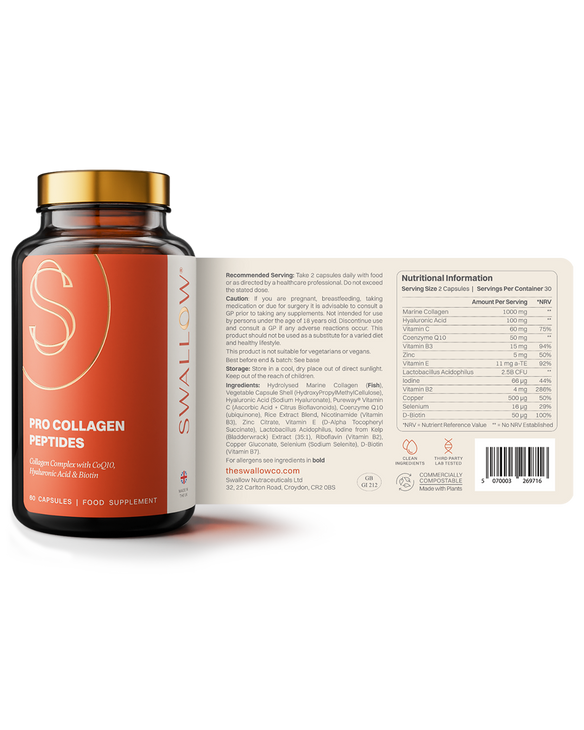
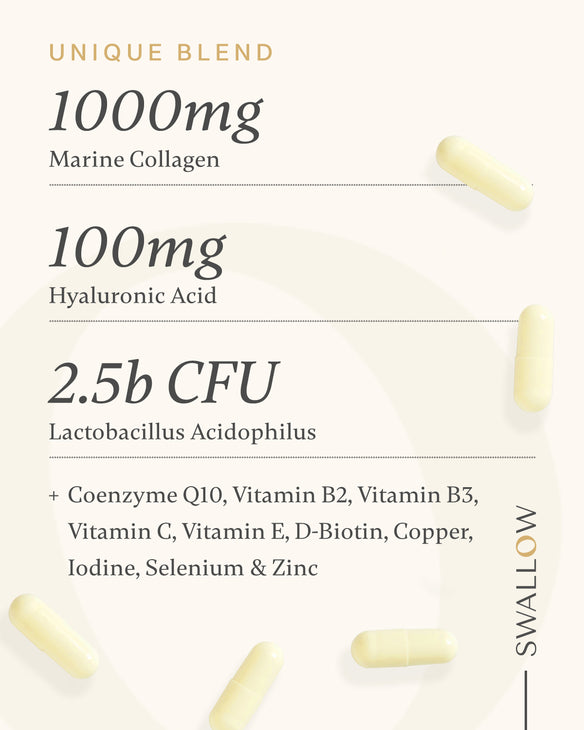
Swallow's skin, hair and nail support supplements are formulated around exactly these criteria. The Marine Collagen Peptides provides hydrolysed marine collagen at a clinically relevant dose alongside hyaluronic acid, PureWay-C, zinc bisglycinate, and biotin, all in a single daily capsule dose. For broader antioxidant and vitamin C support, the Daily Multivitamin complements the collagen formula with methylated B vitamins and PureWay-C.
|
RELATED READING Oxidative stress connects directly to immune function as well as skin appearance. You can read more about the immune side of antioxidant nutrition in our immunity article. For the full clinical case for hydrolysed marine collagen and skin elasticity, our collagen article covers the research in depth. |
References:
Sinclair RD (2002). Clinical Dermatology, 20(6).
Rinnerthaler M et al. (2015). Biomolecules, 5(2).
Schagen SK et al. (2012). Dermato-Endocrinology, 4(3).
Palma L et al. (2015). Skin Research and Technology, 21(1).
Proksch E et al. (2014). Skin Pharmacology and Physiology, 27(1).
Shigemura Y et al. (2009). Journal of Agricultural and Food Chemistry, 57(2).
Kim J et al. (2018). Marine Drugs, 16(12).
Kawada C et al. (2014). Archives of Dermatological Research, 306(2).
Gollner I et al. (2017). Journal of Medicinal Food, 20(12).
Cosgrove MC et al. (2007). American Journal of Clinical Nutrition, 86(4).
Pullar JM et al. (2017). Nutrients, 9(8).
Dreno B et al. (2018). Journal of the European Academy of Dermatology and Venereology, 32(8).
Floersheim GL (1989). Zeitschrift fur Hautkrankheiten, 64(1).