You have taken collagen every morning for three weeks. You have looked in the mirror more times than you would admit. And so far, nothing.
That is completely normal. Collagen usually takes eight to twelve weeks of daily use before results become obvious, with the earliest changes around week four to six. Almost every clinical trial measuring skin hydration runs for at least eight weeks, because that is how long it takes for anything measurable to happen.
So the real question is, how long does collagen take to work for you, rather than for a study participant with a probe strapped to their forearm?
It depends what you want to change. Skin, hair, nails and joints each run to a different clock.
At a Glance: When to Expect Results
At a glance
Collagen typically takes 8 to 12 weeks of daily use to produce noticeable results. Skin hydration is usually the first thing to change, often measurable from around week four. Nails are frequently the first change people notice themselves, because a fingernail grows roughly 3.5 mm a month, so strength and peeling improve before length does. Hair and joints are slower, generally needing 12 to 24 weeks.
Consistency matters more than the size of your dose. A serving taken every day for three months does considerably more than a larger amount taken now and again.
How Long Collagen Takes to Work by Body Area
Collagen is not a single-purpose supplement, and the tissues it supports renew at very different speeds. Skin cells turn over in weeks. A fingernail takes months to replace. Cartilage is slower still.
| Body area | First changes | Clearer results | Why it takes that long |
|---|---|---|---|
| Skin hydration | 4 to 6 weeks | 8 to 12 weeks | Water-binding in the upper dermis responds before deeper structure |
| Skin elasticity and fine lines | 8 weeks | 12 weeks and beyond | Rebuilding the dermal matrix is slow structural work |
| Nails | 4 to 8 weeks | 12 to 24 weeks | Fingernails grow 3.47 mm a month, so a full nail takes 4 to 6 months |
| Hair | 8 to 12 weeks | 16 to 24 weeks | Scalp hair grows around 1 cm a month on a multi-year follicle cycle |
| Joints | 8 to 12 weeks | 12 to 24 weeks | Cartilage turnover is slow, and joint comfort trials run 3 to 6 months |
How Long Does Collagen Take to Work on Skin?
Collagen takes around eight to twelve weeks to produce a visible change in skin, with hydration improving first and elasticity and fine lines following later. Skin has by far the strongest evidence behind it.
A systematic review and meta-analysis of hydrolysed collagen supplementation on skin ageing pooled 19 randomised, double-blind trials covering 1,125 participants and concluded that 90 days of daily use improved hydration, elasticity and wrinkle appearance compared with placebo. A larger analysis of 26 randomised controlled trials involving 1,721 patients reached the same conclusion, and found that how long people supplemented for changed the result.
Day to day this is less dramatic than the marketing suggests. The first thing most people mention is not fewer lines. It is that their face stops feeling tight after washing, or that foundation stops settling into the creases.
Skin is also the one area where the gut has a say, which is why some people pair collagen and probiotics rather than treating skin as purely structural.
Worth knowing
Be sceptical of any brand promising results in a fortnight. A 2025 meta-analysis of 23 trials found that studies funded by supplement manufacturers reported significant benefits, while independently funded and higher-quality studies did not. Collagen is well tolerated and the evidence leans positive, but effect sizes in the best-designed research are modest. That is why the timeline is months, not days.
How Long Does Collagen Take to Work on Hair?
Collagen typically takes twelve to twenty-four weeks to make a noticeable difference to hair, considerably longer than skin. The reason is how hair grows, not the supplement.
Scalp hair grows at roughly one centimetre a month, and every follicle runs its own multi-year cycle of growth, transition and rest. The hair you can see today was made months ago, and nothing you swallow this week will change it. Supplementation can only influence the hair being built at the follicle now, so you are waiting for that growth to become long enough to see.
The evidence base here is thinner than for skin, and it is fair to say so. A randomised, double-blind, placebo-controlled trial of low-molecular-weight collagen peptide in adults with damaged hair ran for 24 weeks before reporting improvements in hair diameter, tensile strength and gloss. Twenty-four weeks. That is the realistic window, not eight.
If you are taking collagen because your hair has thinned through perimenopause, this is the part to hold on to. Eight weeks in with no visible change is not failure. It is precisely what the growth cycle predicts.
How Long Does Collagen Take to Work on Nails?
Nails often show the earliest change people notice, usually between four and eight weeks, with clearer results by twelve to twenty-four weeks.
Nail growth has a precise, well-measured figure attached. Research into the growth rate of human fingernails and toenails in healthy young adults found fingernails grow an average of 3.47 mm a month and toenails just 1.62 mm. A full fingernail takes roughly four to six months to replace itself from base to tip. Judge collagen on nail length alone and you are committing to half a year.
Nails still feel like the fastest win because you are not really judging length. You are judging whether the tips have stopped peeling and whether you have gone a fortnight without one splitting on the dishwasher. That shows up in the new growth near the cuticle.
The clinical work on nails is limited but consistent. A study on oral supplementation with specific bioactive collagen peptides for nail growth and brittle nails recorded a 12% increase in nail growth rate and a 42% drop in broken nails over 24 weeks, with 64% of participants clinically improved. It was a small, open-label trial of 25 people, so treat it as encouraging rather than conclusive.
How Long Does Collagen Take to Work on Joints?
Joints are the slowest area. Expect twelve to twenty-four weeks before you can fairly judge whether collagen is helping, and what changes is comfort during movement rather than the joint itself.
The trial durations tell the story. A 24-week study on the use of collagen hydrolysate as a dietary supplement in athletes with activity-related joint pain ran for six months, as did a separate six-month randomised, double-blind, placebo-controlled study on the effect of collagen hydrolysate in articular pain. When a meta-analysis of the analgesic efficacy of collagen peptide in knee osteoarthritis pooled four trials covering 507 patients, it found significant pain relief against placebo, though all four carried a high risk of bias.
People rarely describe joint improvement as pain disappearing. They describe the first ten minutes of the morning being less stiff, or gardening on a Sunday and not paying for it on the Monday. Those signals creep up on you.
What Affects How Quickly Collagen Works
Two people can start the same supplement on the same day and have very different experiences twelve weeks later. These are the variables behind that gap.
Consistency, which matters more than anything else
This is the biggest factor and the one people underestimate. Collagen does not build a reserve you can dip into. It provides raw material your body uses within hours, so a missed day is a day of building material your skin, hair and nails did not get. Four days a week for three months is not a shorter version of the same result. It is a weaker one, and it explains why someone who started in January still sees nothing in April.
Attaching it to something you already do without thinking is the fix. Next to the kettle, or beside your toothbrush.
Your daily dose
Trials have used a wide range of daily amounts, and the results do not line up with dose size as neatly as you would expect. More is not automatically better. How well the collagen is absorbed, and what is taken alongside it, matters at least as much as the quantity on the label.
The form: powder, tablets, capsules or liquid
How long collagen powder takes to work is essentially the same as how long capsules or tablets take, provided both are hydrolysed. Hydrolysis is the step that matters, because it breaks the protein into short peptide chains your gut absorbs easily. Format is a question of what you will stick with. Powder suits people who already make a morning coffee. Capsules suit anyone who travels or dislikes the taste. Source is separate, and we have compared marine and bovine collagen if you are choosing between them.
Your age and where you are starting from
Analysis of age-related dermal collagen changes during development, maturation and ageing found that from around the age of 20 we lose roughly 1.5% of our dermal collagen every year. That cuts both ways. A 28-year-old with good skin has less room to improve and may see very little. A 55-year-old going through the menopausal collagen drop has more ground to make up and often notices more. Diet, sleep, smoking and sun exposure sit on top of that.
Vitamin C and the other co-factors
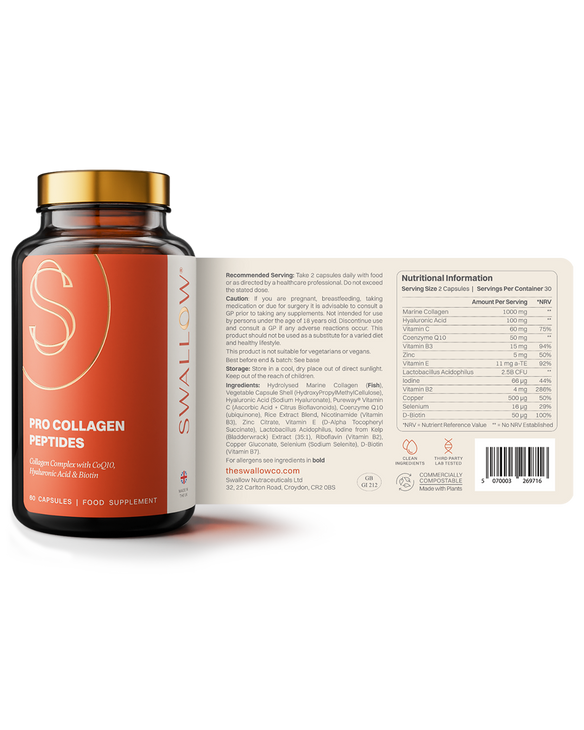
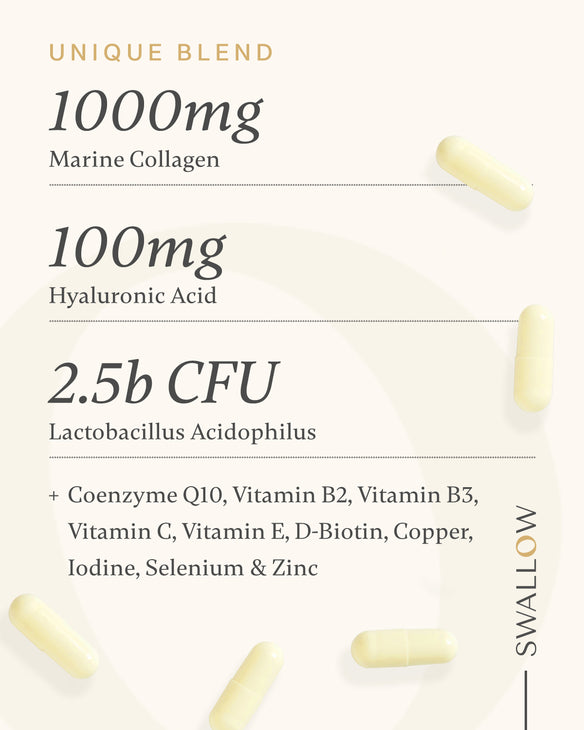
This one gets overlooked constantly. Your body does not lay collagen peptides straight into your skin. It breaks them down and rebuilds, and that rebuilding needs vitamin C, which contributes to normal collagen formation for the normal function of skin. Zinc contributes to normal skin, hair and nails, copper to normal connective tissues, and biotin to normal hair and skin. Taking collagen without them is like having bricks delivered with no cement. Our marine collagen peptides are formulated with those co-factors for exactly this reason.
How to Tell If Your Collagen Is Working
The changes are gradual, which makes them hard to notice from the inside. These are the signs that tend to appear, roughly in order:
- Skin feels less tight after cleansing, and make-up sits better through the day
- Nail tips stop peeling and you go longer between breakages, before length changes at all
- Fine lines look softer in natural light, usually noticed by someone else before you spot it
- New hair growth near the parting looks slightly thicker, from around month four
- Morning stiffness eases, or a familiar movement stops being something you brace for
Take a photo on day one. Same room, same light, same time of day, no make-up. Repeat at week six and week twelve. Twelve weeks of gradual change is impossible to hold in your memory, and the photograph is the only honest referee you have.
If you reach twelve full weeks of genuinely daily use and nothing has shifted, check the obvious things first. Are you taking it every day? Is the collagen hydrolysed? Are you getting vitamin C alongside it? There are a handful of collagen mistakes worth ruling out before you decide it does not work for you. If your concern is hair or joints, you may simply be looking too early.
Do You Need to Take Collagen Forever?
Results do not vanish the moment you stop, but they fade over time if you stop for good.
The short-term picture is reassuring. A randomised, double-blind, placebo-controlled study on the sustained effects of bioactive collagen peptides on skin health followed 77 women through 12 weeks of supplementation and a four-week washout. The improvements in dermal density and hydration held through the washout. The nail research found the same, with 88% still showing improvement four weeks after stopping.
The longer-term picture is simple biology. The annual decline in your own collagen production carries on regardless, so whatever you built gets gradually worn back down. Think of it like exercise. Nobody expects to stop training in March and still be fit in December. Collagen is a maintenance habit, not a course of treatment, which is why the best results come from the people who have taken it longest.
Conclusion
Collagen works slowly, and anything promising otherwise is not being straight with you. Give it eight to twelve weeks for skin, four to eight weeks for nails, and up to six months for hair and joints. The thing most within your control is not the dose or the format. It is taking it every day, for long enough to matter.
To understand more about what you are taking, we have written in detail on what marine collagen does for skin, hair and joints. If you are starting from scratch, our marine collagen peptides pair type I marine collagen with the vitamin C, zinc, copper and biotin your body needs to use it. Take it daily, mark the date, and check back in twelve weeks.
References
-
Effects of hydrolyzed collagen supplementation on skin aging: a systematic review and meta-analysis
de Miranda RB, Weimer P, Rossi RC. International Journal of Dermatology, 2021. -
Effects of Oral Collagen for Skin Anti-Aging: A Systematic Review and Meta-Analysis
Pu S, Chen H, Zhou C, et al. Nutrients, 2023. -
Effects of Collagen Supplements on Skin Aging: A Systematic Review and Meta-Analysis of Randomized Controlled Trials
The American Journal of Medicine, 2025. -
Efficacy and safety of hydrolyzed collagen supplementation on skin health outcomes: a systematic literature review of randomized controlled trials
Systematic literature review of 25 randomised controlled trials. -
Oral intake of specific bioactive collagen peptides reduces skin wrinkles and increases dermal matrix synthesis
Proksch E, Schunck M, Zague V, et al. Skin Pharmacology and Physiology, 2014. -
Ingestion of bioactive collagen hydrolysates enhance facial skin moisture and elasticity and reduce facial ageing signs in a randomised double-blind placebo-controlled clinical study
Inoue N, Sugihara F, Wang X. Journal of the Science of Food and Agriculture, 2016. -
The Sustained Effects of Bioactive Collagen Peptides on Skin Health: A Randomized, Double-Blind, Placebo-Controlled Clinical Study
12-week supplementation followed by a 4-week washout in 77 women. -
Oral supplementation with specific bioactive collagen peptides improves nail growth and reduces symptoms of brittle nails
Hexsel D, Zague V, Schunck M, et al. Journal of Cosmetic Dermatology, 2017. -
Growth rate of human fingernails and toenails in healthy American young adults
Yaemsiri S, Hou N, Slining MM, He K. Journal of the European Academy of Dermatology and Venereology, 2010. -
Efficacy and Safety of Low-Molecular-Weight Collagen Peptide GT for Improving Hair Condition in Individuals with Damaged Hair: A Randomized, Double-Blind, Placebo-Controlled Trial
24-week randomised controlled trial in adults with mild to moderate hair damage. -
24-Week study on the use of collagen hydrolysate as a dietary supplement in athletes with activity-related joint pain
Clark KL, Sebastianelli W, Flechsenhar KR, et al. Current Medical Research and Opinion, 2008. -
Effect of collagen hydrolysate in articular pain: a 6-month randomized, double-blind, placebo-controlled study
Bruyere O, Zegels B, Leonori L, et al. Complementary Therapies in Medicine, 2012. -
Analgesic efficacy of collagen peptide in knee osteoarthritis: a meta-analysis of randomized controlled trials
Four randomised controlled trials covering 507 patients with knee osteoarthritis. -
Age-related dermal collagen changes during development, maturation and ageing: a morphometric and comparative study
Marcos-Garces V, Molina Aguilar P, Bea Serrano C, et al. Journal of Anatomy, 2014.